
Satisfies 1 requirement
Hl Column Pin Coupling Hl5 High Torque Shaft Coupler for Ball Mills & Shredders with Forged Steel Nylon Pins-V
US$19.50-980.00
1 Set(MOQ)

I have found results from60000+products and20000+suppliers aboutForged steel coupling


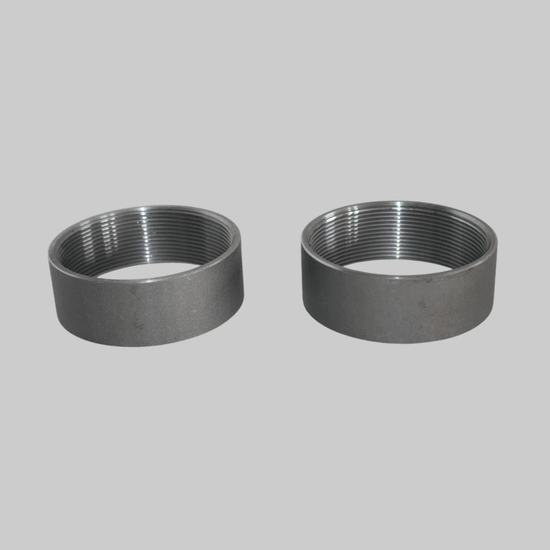


Selecting the correct material is critical for pressure containment and durability. For standard high-pressure applications, ASTM A105 is the most common carbon steel grade. For low-temperature environments, specify ASTM A350 LF2. If the application involves corrosive media, opt for stainless steel grades like ASTM A182 F304L or F316L to prevent oxidation and chemical degradation.
Ensure all couplings comply with ASME B16.11, which governs dimensions and ratings for forged fittings. You must verify the pressure class—typically 3000#, 6000#, or 9000#—to match your piping system's requirements. For threaded versions, confirm the thread type, such as NPT (National Pipe Thread) or BSPT, to ensure leak-proof connections.
To ensure structural integrity, request a Material Test Report (MTR) for every heat number. Key tests include Hydrostatic Testing to check for leaks, Ultrasonic or Magnetic Particle Inspection (MPI) to detect internal cracks or surface flaws, and Hardness Testing to ensure the forging process met the required specifications.
Forged couplings are superior to cast ones because the forging process creates a continuous grain flow, resulting in higher impact strength and fatigue resistance. Always confirm the supplier uses a closed-die forging process rather than machining from bar stock for high-pressure components to ensure maximum safety.
Utilize Third-Party Inspection (TPI) services like SGS or BV to conduct pre-shipment inspections. On Made-in-China.com, prioritize Audited Suppliers who have undergone comprehensive on-site factory verifications. Always request a pre-production sample to verify dimensions and thread precision before authorizing mass production.
Focus on Total Cost of Ownership (TCO) rather than just the unit price. Negotiate based on volume-tiered pricing; for forged steel, a 10-15% discount is often achievable for orders exceeding 2,000 pieces. Additionally, negotiate for customized marking/branding and seaworthy VCI (Volatile Corrosion Inhibitor) packaging to be included in the quote.
Forged steel is heavy and prone to rust during sea transit. Ensure the contract specifies anti-rust oil coating and reinforced wooden crate packaging to prevent shifting. For international trade, FOB (Free On Board) is recommended for experienced buyers to maintain control over freight costs, while CIF (Cost, Insurance, and Freight) is better for those seeking a simplified logistics chain.
Use Secured Payment services provided by reputable B2B platforms to ensure funds are only released upon proof of shipment. Verify the HS Code (typically 730719) to calculate accurate import duties and ensure compliance with anti-dumping regulations that may apply to steel products in your specific region.